About Marathon Man
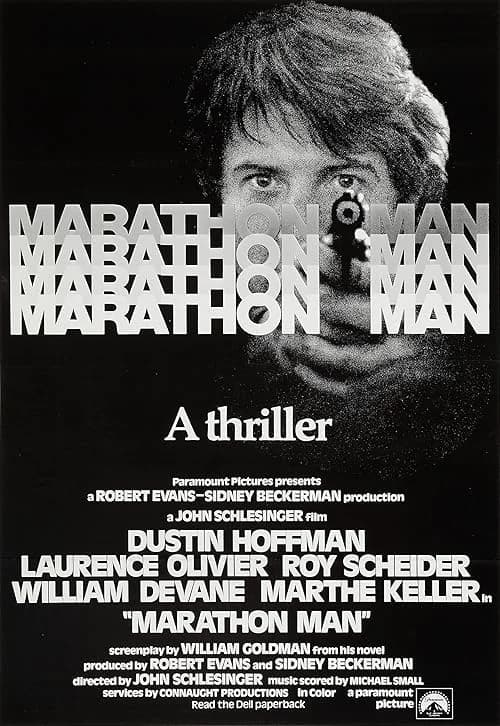
Marathon Man (1976) stands as one of the most gripping and psychologically intense thrillers of its era, masterfully directed by John Schlesinger. The film follows Thomas 'Babe' Levy (Dustin Hoffman), a Columbia University history student whose life unravels when his older brother Henry (Roy Scheider) is murdered. Babe soon finds himself pursued by shadowy figures connected to a Nazi war criminal living in hiding, Dr. Christian Szell (Laurence Olivier in a chilling performance), who is desperately trying to retrieve a cache of smuggled diamonds.
The film's tension builds expertly through its complex plot involving government agents, international conspiracies, and personal vengeance. Hoffman delivers one of his most committed performances, particularly in the infamous dental torture scene that has become iconic in cinematic history. Olivier's portrayal of the calculating, cruel Szell remains one of cinema's most memorable villains, his polite menace contrasting sharply with Hoffman's increasingly desperate protagonist.
Schlesinger's direction creates a palpable sense of paranoia throughout New York City's streets, enhanced by Conrad Hall's atmospheric cinematography. The screenplay by William Goldman (based on his own novel) expertly balances character development with relentless suspense. What makes Marathon Man particularly compelling decades later is its exploration of historical trauma's lingering effects and how ordinary people can become caught in extraordinary circumstances. For viewers seeking a thriller that combines intellectual depth with edge-of-your-seat tension, Marathon Man remains essential viewing, showcasing 1970s American cinema at its most sophisticated and unsettling.
The film's tension builds expertly through its complex plot involving government agents, international conspiracies, and personal vengeance. Hoffman delivers one of his most committed performances, particularly in the infamous dental torture scene that has become iconic in cinematic history. Olivier's portrayal of the calculating, cruel Szell remains one of cinema's most memorable villains, his polite menace contrasting sharply with Hoffman's increasingly desperate protagonist.
Schlesinger's direction creates a palpable sense of paranoia throughout New York City's streets, enhanced by Conrad Hall's atmospheric cinematography. The screenplay by William Goldman (based on his own novel) expertly balances character development with relentless suspense. What makes Marathon Man particularly compelling decades later is its exploration of historical trauma's lingering effects and how ordinary people can become caught in extraordinary circumstances. For viewers seeking a thriller that combines intellectual depth with edge-of-your-seat tension, Marathon Man remains essential viewing, showcasing 1970s American cinema at its most sophisticated and unsettling.