
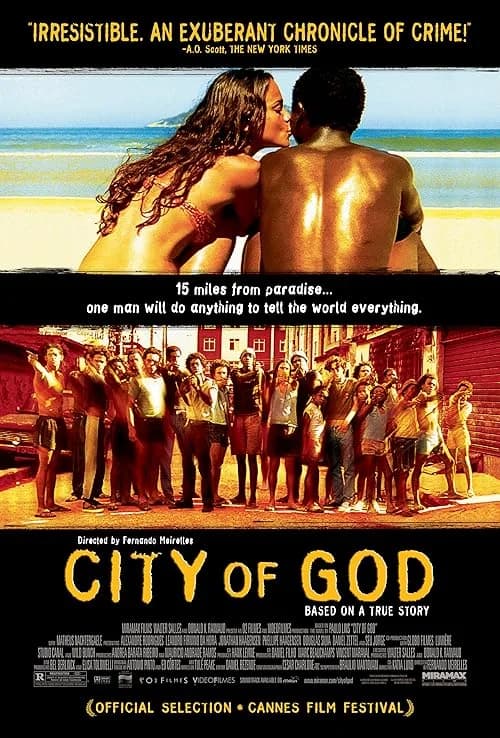
About City of God
City of God (Cidade de Deus) is a landmark 2002 Brazilian crime drama that offers a raw, unflinching look at life in Rio de Janeiro's notorious favelas. Directed by Fernando Meirelles and Kátia Lund, the film follows the diverging paths of Rocket, an aspiring photographer trying to escape the violence, and Li'l Zé, who rises to become a brutal drug lord. Through Rocket's lens, we witness the cyclical nature of poverty and crime across three decades.
The film's documentary-style cinematography and kinetic editing create an immersive, almost visceral experience. The performances, particularly from the largely non-professional cast, are astonishingly authentic. Alexandre Rodrigues brings a quiet humanity to Rocket, while Leandro Firmino delivers a terrifying portrayal of Li'l Zé's unchecked ambition and cruelty.
City of God succeeds not just as a gripping crime saga but as a profound social commentary. It explores how environment shapes destiny while maintaining relentless narrative momentum. The film's structure, weaving multiple character arcs across different time periods, demonstrates masterful storytelling. Its international acclaim, including four Oscar nominations, is well-deserved.
Viewers should watch City of God for its unparalleled authenticity, emotional power, and technical brilliance. It remains one of the most important films about urban violence ever made, offering insights that resonate far beyond its Brazilian setting. The movie's energy, unforgettable characters, and moral complexity make it essential viewing for anyone interested in world cinema or powerful human stories.
The film's documentary-style cinematography and kinetic editing create an immersive, almost visceral experience. The performances, particularly from the largely non-professional cast, are astonishingly authentic. Alexandre Rodrigues brings a quiet humanity to Rocket, while Leandro Firmino delivers a terrifying portrayal of Li'l Zé's unchecked ambition and cruelty.
City of God succeeds not just as a gripping crime saga but as a profound social commentary. It explores how environment shapes destiny while maintaining relentless narrative momentum. The film's structure, weaving multiple character arcs across different time periods, demonstrates masterful storytelling. Its international acclaim, including four Oscar nominations, is well-deserved.
Viewers should watch City of God for its unparalleled authenticity, emotional power, and technical brilliance. It remains one of the most important films about urban violence ever made, offering insights that resonate far beyond its Brazilian setting. The movie's energy, unforgettable characters, and moral complexity make it essential viewing for anyone interested in world cinema or powerful human stories.